How to focus, despite AI

My days now run from the terminal. In July, they often looked like this:
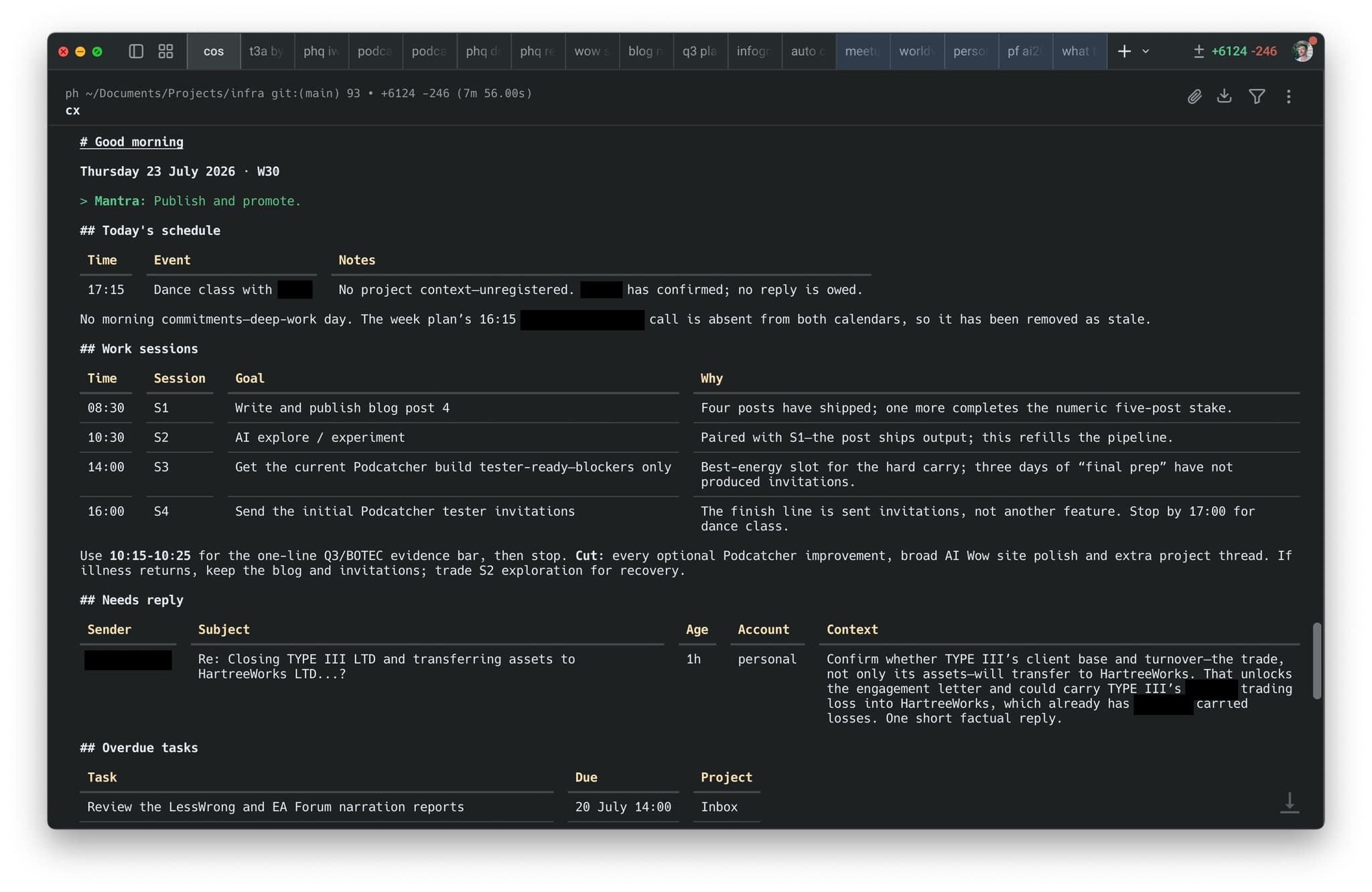
Tabs, notifications, agents waiting... this interface is not good for focussed work. It’s like keeping Slack open with a large human team, who are constantly waiting on me to unblock them.
Preface: how to change behaviour
BJ Fogg says:
- To do something less, avoid triggers and make it harder.
- To do something more, increase triggers and make it easier.
If you want to drink less coffee, don’t keep it in the house. To eat more apples, keep some on your desk.
Why my July environment was terrible
What I want:
- Do less: engage distracting tasks during deep work sessions.
- Do more: capture tasks for later (à la GTD).
My July setup was bad for this. There were unhelpful triggers:
- Many tabs in flight, constantly visible. Within each tab, many panes. Each one has a strong pull (“I’ll just unblock this one, so the agent keeps making progress while I do other stuff”).
- Notifications whenever an agent has questions, needs permission, or finishes a turn.
And the affordances were wrong: it was easier to start/resume tasks than to capture them for later.
Changes for August
First, go nuclear: I’m back to starting the morning with pen and paper. 15+ mins, laptop in bag.
Second, remove unhelpful triggers:
- I now close all agent tabs before deep work sessions.
- I’ve added a “do not disturb” mode to disable agent notifications.
- I’ve fixed the morning briefing. My preferred work pattern is: deep work first thing; avoid non-urgent inboxes until at least 11am. My briefing now reflects that, with all non-urgent inbox checks moved to a
/deskskill, which I run later in the day.
Third, adjust difficulty:
- I’ve made starting tasks harder: if I get distracted, an agent yells at me.
- I’ve made capturing tasks easier:
- In Todoist, I’ve made a dedicated inbox for agents.2
- To add to the agent inbox, I type
#ain the prompt box (or Todoist). - If an in-flight session spirals, I type
#pto add to a separate “in flight” inbox (this invokes the park hook mentioned above). - (Of course, the Todoist “add” dialog is a single button on my phone, and a single shortcut on my MacBook.)
Thoughts
Phew. The fundamentals are no longer broken.
I’ve been into deep work and attention design since forever—it’s odd that I let things get so bad in the past few months. Two things I’d have expected to catch this:
- My own reflection, during my week reviews
- My AI manager/coach feedback (also during week reviews)
If I were coaching someone with this problem, I’d have seen it quickly and yelled at them. My AI manager/coach really dropped the ball here—I’ll review the skill.
But how did I miss this? Honestly, I’m mystified—and a bit shocked. Some ideas:
- Frog-boil: my AI agents have gradually become much more like a (big) human team. There was not a discrete moment to trigger “ok, I’m about to hire 10 people, obviously I need to look at attention design”.
- Independent work: I’ve done much more solo work lately, with fewer rock-solid deadlines. If I’d missed a client deadline, there would have been a careful post-mortem. As it was, several notable misses did not trigger this.
- Cognitive compromise: a vague label, but I do have the sense that—amidst the uplift—my intense collaboration with AI is causing some diffuse cognitive problem(s).
- It might mostly be that I’ve recently had a hard time with ”while you wait, think for yourself″—precisely due to the distraction issue I’m fixing here.
- In general my mind feels more unsettled and distractible, even when I’m not at my desk. It feels like I need to meditate more, to train myself back to a calmer default state.
- The start morning with pen and paper pattern helps mitigate this.